


A solo operator in the personal finance space published one hundred and forty-seven articles over eighteen months. No team. No social media grind. No face on camera. By month nineteen, that site was pulling in owned traffic that converted into mid-four-figures every single month — while he slept. He used AI to build the content system, not just write the articles. That distinction is everything. This guide breaks down exactly how AI content strategies work at that level, which tools move the needle in 2026, and how you set up the same kind of compounding system for yourself.
Why Most People Get AI Content Wrong Before They Even Start

Here is what most creators do. They open ChatGPT, type a prompt, paste the output into WordPress, and wonder why Google ignores it. That is not an AI content strategy. That is copy-paste with extra steps.
The real answer is that AI is an infrastructure tool, not a writing shortcut. The operators building passive income websites that actually rank in 2026 are using AI to handle the repeatable, low-judgment parts of content production — keyword clustering, outline generation, internal link mapping, metadata — while they keep human attention on the one thing AI still cannot fake: genuine topical authority and editorial judgment.
Skip that distinction and you will produce a lot of content that goes nowhere. Respect it and you can run a publishing operation at a scale that would have required a full editorial team five years ago.
The Architecture of a Working AI Content System
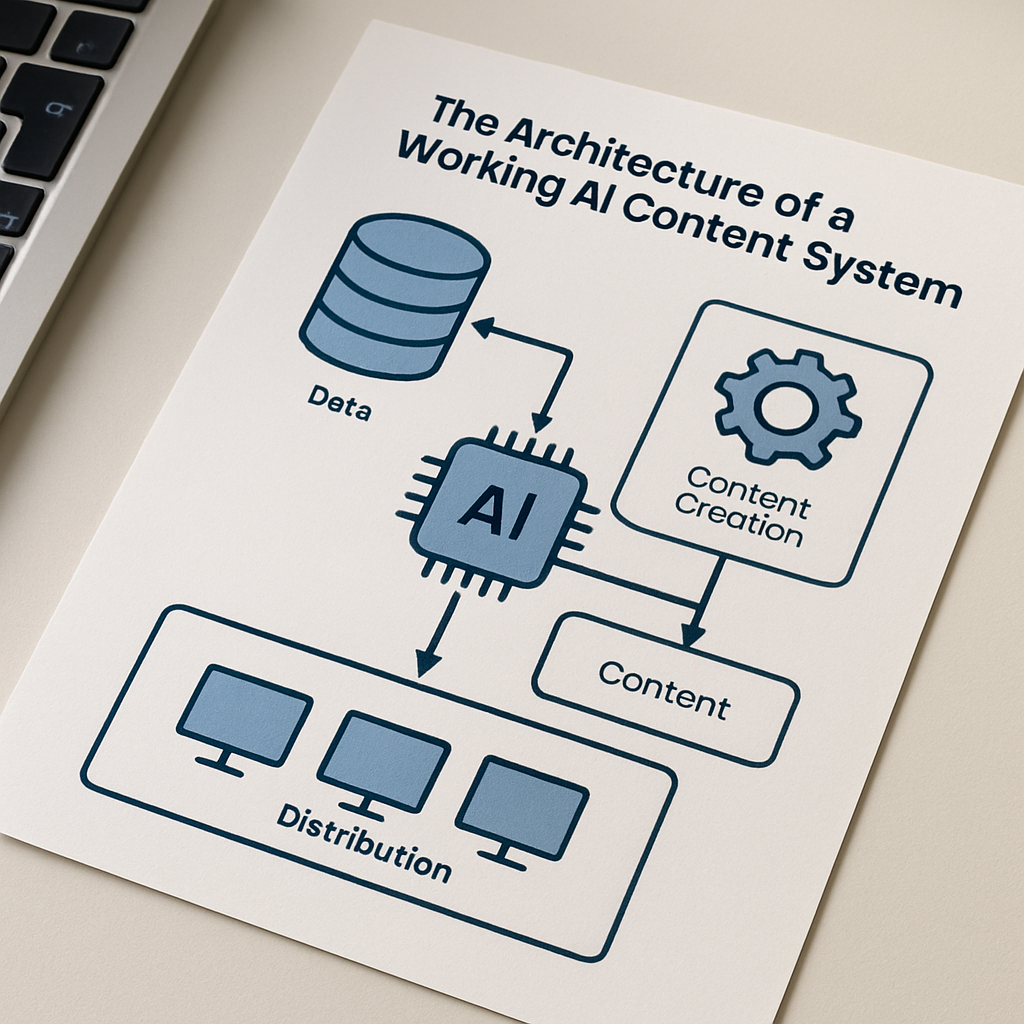
Think of your content system in three layers. Each layer feeds the next. Get the architecture right first and the AI tools slot in cleanly. Get it wrong and no tool fixes it.
Layer 1 — The Topical Map
Before you write a single word, you need a topical map. This is a structured list of every question, subtopic, and comparison your target reader might search across the full buying and learning journey in your niche. A solid topical map for a mid-sized niche might contain between eighty and two hundred and fifty individual content targets.
AI handles this layer well. Feed a tool like ChatGPT or Claude a seed topic and ask it to generate a full hub-and-spoke content map organized by search intent — informational, navigational, commercial, transactional. Then cross-reference those topics against a keyword tool like Ahrefs or Ubersuggest to filter by realistic difficulty scores. You are not chasing volume. You are stacking winnable positions that compound over time.
This is the foundation of every AI content automation system worth building. Without it, you are publishing randomly and hoping something sticks.
Layer 2 — The Production Pipeline
Once your map exists, the production pipeline is where AI earns its keep. A repeatable pipeline looks like this:
- ✅ Brief generation: Use AI to build a detailed content brief from each target keyword — covering angle, headers, entities to mention, and competitor gaps to exploit.
- ✅ First draft: Use a long-form AI writing tool (Jasper, Koala, or a well-engineered GPT-4o prompt chain) to generate a structured first draft from the brief.
- ✅ Editorial pass: A human — you, a part-time editor, or a trained VA — reads for accuracy, adds first-person proof points, and cuts anything that sounds generic.
- ✅ On-page optimization: Run the draft through a tool like Surfer SEO or NeuronWriter to check entity coverage and semantic completeness before publishing.
- ✅ Internal linking: Use your site’s existing content map to manually insert two to four internal links per article before it goes live.
That pipeline, once dialed in, lets a single operator publish four to six optimized articles per week without burning out. That is the compounding engine.
Layer 3 — The Feedback Loop
Most people skip this layer entirely, which is why their traffic plateaus. The feedback loop means checking Google Search Console every thirty days, identifying which articles are ranking on page two or three, and feeding that data back into your AI system to generate targeted updates and supporting cluster articles.
A page sitting at position eleven to twenty is not a failure. It is a signal. It means Google already considers you relevant — you just need more topical depth around that piece. AI can generate that supporting content in hours. A human editor would take days. That speed advantage is where the real compounding happens.
The Tools That Actually Matter in 2026

There is no shortage of AI writing tools competing for your subscription dollars. Here is a plain breakdown of what each category does and which tools are worth the spend at different stages.
For Keyword Research and Topical Authority
Ahrefs remains the most reliable data source for keyword difficulty and backlink analysis. The Lite plan runs around ninety-nine dollars per month. If that is outside your budget at launch, Ubersuggest offers a lifetime deal that covers the basics for a one-time fee under a hundred dollars. Either way, do not skip this layer. Guessing at keywords is how you spend six months writing content nobody ever finds.
For AI-Assisted Writing
Koala AI is worth a serious look for operators building passive income websites in 2026. It pulls real-time search data, structures articles around the top-ranking SERP competitors, and outputs content that is closer to publication-ready than most tools in its price range. Plans start around nine dollars per month for light usage.
Jasper is the enterprise-tier option. It costs more — plans start around forty-nine dollars per month — but the brand voice controls and workflow integrations make it worth it once you are running a multi-site operation or managing a small content team.
For beginners, a well-structured prompt chain inside ChatGPT Plus at twenty dollars per month covers a surprising amount of ground before you need to upgrade to a dedicated tool.
For On-Page SEO Optimization
NeuronWriter is the budget-friendly pick. A lifetime deal on AppSumo has historically run between sixty and ninety-nine dollars. It scores your content against top-ranking competitors and tells you exactly which entities and terms you are missing. Surfer SEO is the premium alternative at around eighty-nine dollars per month — it integrates directly into Google Docs and Jasper, which makes it faster in a high-volume pipeline.
For Your Foundation
Before any of these tools matter, you need a domain and hosting. Register your domain through Namecheap — domains run around ten to thirteen dollars per year, and their interface is clean enough that a beginner can get set up in under twenty minutes. Own your infrastructure. Building on rented social platforms means you are growing someone else’s asset, not yours.
For deeper context on why owned traffic matters more than any single tool, the The Silent Webmaster blog breaks down the fundamentals in plain language with real numbers attached.
A Real-World Case Study: The Faceless Finance Site

Let’s go back to that personal finance operator. Here is how the system actually ran.
Month one through three: he built a topical map of one hundred and ninety-two content targets across four sub-niches — budgeting, debt payoff, side income, and credit repair. AI generated the map in about four hours of prompt work. Keyword filtering took another two days.
Month four through twelve: the production pipeline ran at four articles per week. Each article went through the brief-draft-edit-optimize loop described above. Total human attention per article averaged about ninety minutes. The rest was AI-assisted.
Month thirteen through eighteen: the feedback loop kicked in. Thirty-one articles were sitting between position eight and position twenty in Google. He used AI to generate supporting cluster articles for each of those pieces — two to three per target. Within sixty days, nineteen of those thirty-one articles moved to page one.
By month nineteen, the site had one hundred and forty-seven published articles, a domain rating that had climbed steadily through organic link acquisition, and owned traffic that converted through display ads and affiliate placements into consistent monthly income. No paid traffic. No social media account. No email list at launch. Those are the receipts.
That is what a working AI content strategy looks like when you treat it as a system instead of a shortcut.
What to Build First If You Are Starting From Zero
Do not try to build everything at once. Here is the sequence that works:
- Pick one niche with real buyer intent. Personal finance, health, software reviews, home improvement, and legal information all have strong monetization potential. Avoid niches where the top results are all government or university sites — you will not outrank them without years of authority building.
- Register your domain and set up WordPress. Keep the tech stack simple at the start. WordPress with a lightweight theme like GeneratePress or Kadence handles everything you need.
- Build your topical map before you write anything. Spend the first two weeks on research and architecture. This is the step most people skip, and it is the reason most content sites stall out before they gain traction.
- Set a publishing cadence you can actually maintain. Three articles per week beats seven articles in week one and zero in week three. Consistency is the compounding mechanism.
- Install Google Search Console on day one. You need data from the moment you publish. Waiting until month six to check your numbers means six months of missed optimization signals.
If you want to see how other operators have built these systems from scratch — with the actual steps and tools they used — the tutorials section at The Silent Webmaster covers the technical setup in detail.
The One Mistake That Kills AI Content Systems Early
Publishing AI content without an editorial pass is the single fastest way to build a site that Google ignores. The helpful content updates that rolled out through 2024 and into 2025 were specifically designed to surface this pattern. Thin, generic, unedited AI output gets filtered. Content that demonstrates real experience, specific examples, and genuine editorial judgment gets rewarded.
The fix is straightforward. Every article needs at least one thing AI cannot generate on its own: a real example, a personal observation, a specific number from your own testing, or a direct comparison based on actual use. One paragraph of genuine human input per article is enough to shift the signal. Do not skip it.
Your Next Step
The operators building real income from content in 2026 are not the ones with the biggest budgets or the most followers. They are the ones who built a system and let it run while they sleep. A solid topical map, a repeatable production pipeline, and a consistent feedback loop — that is the whole machine.
Start with the foundation. Get your domain registered, build your topical map, and run your first ten articles through the full pipeline before you judge the results. Owned traffic from organic search compounds slowly at first and then quickly. The operators who quit at month four never see month fourteen.
If you want to go deeper on the technical side — setting up WordPress, structuring your site architecture, or connecting your content system to a simple monetization stack — the episodes archive at The Silent Webmaster has walkthroughs built specifically for solo operators starting from zero. No team required. No audience required. Just a system that runs.
Disclosure: this article may contain affiliate links. If you buy through them, we may earn a small commission at no extra cost to you.



Leave a Reply